
Truscott Property Guide To Choosing The Right Estate Agent
News at Truscott Property | 15/10/2026
Whether selling a property for the first or fiftieth time, choosing the right estate agent will shape your entire selling experience, from how smoothly the process runs to the final price you achieve. If you’re wondering how to choose an estate agent in Edinburgh or how to find the best real estate agent, the answer lies in finding someone who combines deep local knowledge and a proven track record with your property type and neighbourhood, with an honest, considered approach that matches your needs and priorities.
In a market as nuanced as Edinburgh, those qualities matter. The strongest results are rarely achieved through a one-size-fits-all model, but rather through careful positioning, considered marketing, and clear, realistic, and proactive advice. For many sellers, this is where working with an Edinburgh boutique estate agent, one that offers a more white glove estate agency service, can make a meaningful difference.
What makes an estate agent right for you?
When assessing property agents in Edinburgh, it’s worth looking beyond surface-level factors and focusing on what really drives results:
- A strong understanding of your local area, property type, and buyer behaviour in the current market
- High-quality, thoughtful marketing and reach
- A realistic, evidence-led pricing strategy
- Communication style that matches your needs and responsiveness
The most effective agents tend to work in a deliberate way, prioritising quality over volume, and ensuring each property is given the attention it deserves. This is often where more boutique agencies stand apart as they tailor their approach to their clients and build stronger relationships with them.
Step-by-step guide to choosing the right Edinburgh estate agent for you
Step 1: Research and referrals
Start close to home. Recommendations from friends, family, or colleagues often provide the most honest insight into what working with an agent is really like.
From there, broaden your research:
- Review listings similar to your property on online platforms such as Rightmove and OnTheMarket to see which agents represent them
- Read independent customer reviews on Trustpilot, Google My Business, and even Facebook (also pay attention to how businesses respond, if at all, to reviews and feedback)
- Walk around your neighbourhood and look for For Sale Boards, noting the agencies they belong to and the type of properties they represent
Throughout this initial phase, pay close attention to recurring patterns, such as common themes, repeated keywords, or frequently mentioned circumstances. This process will help you compile an initial list of agents to evaluate further, while also giving you a sense of their individual approaches, characteristics, and reputations.
Step 2: Understand your needs
Here are some questions to consider:
- Is achieving the highest possible price your main objective, or are factors such as speed, certainty, or convenience more important?
- Are there any personal or professional circumstances that could influence your sale?
- Is your property typical for the area, or does it need a more careful positioning?
- How familiar are you with the property-selling process, and how much guidance or support would you like?
- Would you prefer a fully managed service, or are you comfortable taking a more hands-on role in the sale?
Taking the time to answer these questions will give you a clearer picture of the type of agent and service that best aligns with your needs, making it easier to assess your options and choose the right fit.
Step 3: Shortlist estate agents
Review the agents you identified in Step 1 and assess how well each aligns with the priorities you defined in Step 2. As you evaluate them, pay particular attention to:
- Their recent sales performance, track record, and client reviews
- Their experience (or lack thereof) with properties similar to yours and in your local area
- The quality and consistency of their marketing materials
- Whether their sales strategy appears thoughtful and tailored, or generic
- How closely their service offering and approach match your specific goals and priorities
Our comparison table can help you assess agents side by side and keep your findings organised.
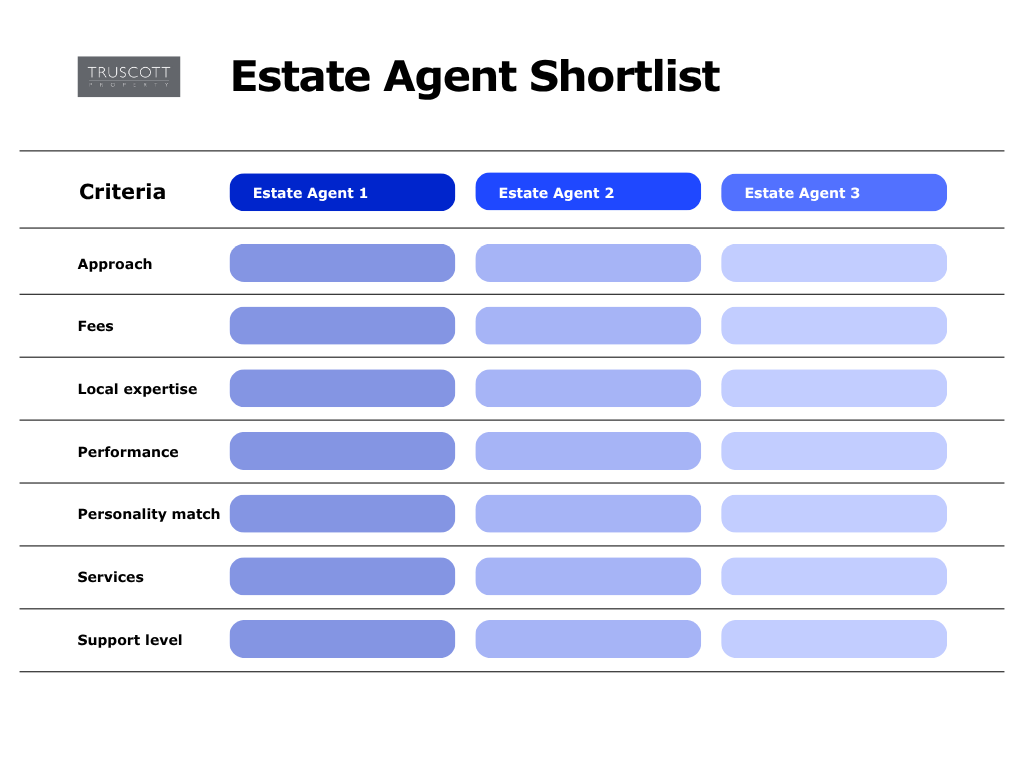
By the end of this stage, you should have a shortlist of 3 agents that stand out as the strongest candidates for further evaluation in the next step.
Step 4: Contact your shortlist and test them
Invite your shortlisted agents to value your property. Treat this as both a market appraisal and an interview.
Meeting agents in person (or virtually) is an important step, as it gives you a realistic sense of what it would be like to work with them and the experience they provide to potential buyers. A market appraisal or valuation is not just about price: it is an opportunity to see how each agent thinks, communicates, and approaches the sale of your property.
Pay attention to how each agent approaches the conversation:
- Do they take time to understand your home and goals?
- Is their market appraisal supported by clear, current, and local evidence?
- Are they laying out a considered strategy or offering a generic pitch?
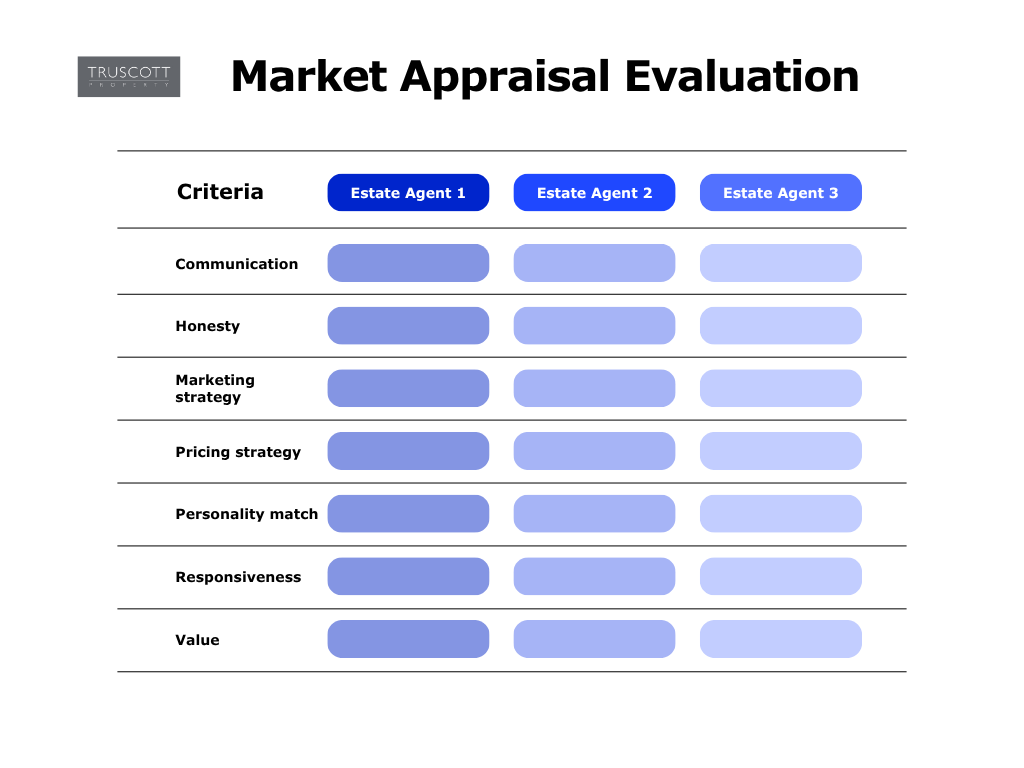
Use the table below to evaluate not only the market appraisal itself, but also the agents’ style, professionalism, preparation, and overall experience leading up to and during their visit. This will help you compare agents consistently and identify those best placed to represent you and your property.
Step 5: Review the market appraisal and cost structure
Once you receive each agent’ market appraisal, review their estimated value, proposed strategy, and fee outline. While it can be tempting to favour the highest valuation, a higher figure is not always the most credible or effective approach. In some cases, it may reflect optimism rather than a well-considered strategy. A strong agent will:
- Provide a market appraisal grounded in comparable sales
- Explain how they intend to generate interest and competition
- Be clear and transparent about their fees
After reviewing their proposal, ask any follow-up questions needed to fully understand their approach and address any uncertainties. This is your opportunity to test their assumptions, expertise, and communication style. The best agents will welcome thoughtful questions and answer them clearly, without overpromising or pressuring you.
Step 6: Review terms and conditions
Before making your final decision, take the time to review the agents’ terms of engagement carefully. Small details can have a significant impact on your experience later in the process. Pay particular attention to:
- Contract length and notice periods
- Exclusivity terms
- Service inclusions
- Any additional or hidden costs
The agreement should set out, in plain language, what you can expect from your agent and what they will expect from you throughout the sale. If anything feels vague, overly restrictive, or difficult to understand, ask for clarification before committing. A strong working relationship starts with clear expectations and complete transparency from both sides.
Step 7: Pull it all together
By this stage, the decision often becomes intuitive and tends to be guided by the following:
- Who has demonstrated genuine insight into your property?
- Who communicates in a way that gives you confidence?
- Who put you at ease?
- Who feels invested in achieving the best possible outcome for you, on your terms?
In many cases, sellers find themselves drawn to agents who take a more personal, considered approach, acting less like salespeople and more like trusted advisors.
How do estate agents work in Scotland?
The process of selling (and buying) property in Edinburgh and Scotland differs slightly from other parts of the UK, and a good estate agent will guide you through it with clarity.
Key points include:
- A Home Report is required before putting a property on the market
- “Offers Over” pricing is a common starting point in the pricing strategy
- Solicitors handle the majority of the conveyancing process
- Interested buyers often place Notes of Interest through their solicitors
- Offers are submitted via solicitors
- Closing Dates can be used to concentrate offers and stimulate existing competition
- Offers become legally binding when missives, a series of letters between solicitors, are concluded
Common mistakes when choosing an estate agent
Choosing an estate agent is not a decision to rush. Small missteps at this early stage can significantly impact both your experience and your final sale outcomes. Here are the most common pitfalls and how to approach them thoughtfully.
-
Choosing based on familiarity only: A well-known brand can feel like a safe choice, but may not always be the right fit. Regardless of reputation, performance can vary between offices or be outdated, and the individual agent you work with may not reflect the standards for which the brand is known
-
Choosing the cheapest agent: While attractive, low or fixed fees can come at the expense of levels of service, attention to detail, or communication, as in many cases, the level of input an agent can dedicate is closely linked to their caseload and fee structure
-
Haggling agency fees significantly: Discussing fees is a natural part of any professional partnership, but pushing too hard can result in a reduced level of service, communication, and overall experience
-
Choosing the highest market appraisal: An ambitious market appraisal can be tempting, but if it isn’t grounded in current market reality, it can lead to your property sitting unsold for extended periods of time. This often results in sharp price reductions later, which can weaken your position and impact buyer perception
-
Relying only on online market appraisals: Well-designed online tools can provide a useful starting point, but they rarely capture the full picture. They can’t account for your property’s unique features, improvements you’ve made, or the more intangible qualities that will make it appealing to buyers
-
Not prioritising local expertise: Edinburgh’s property market is highly localised. Value, buyer behaviour, and effective strategies can vary significantly by area and even sometimes by street. Local insight is therefore essential to positioning your property correctly and achieving strong results.
-
Ignoring communication styles: Clear, consistent, and proactive communication is key to a smooth sale. An agent who is responsive, transparent, and easy to deal with will make a noticeable difference throughout the process, while one who is unclear or slow can cause frustration, misunderstanding, and lead to missed opportunities
-
Choosing a generic strategy: Every home is different, and presenting it effectively requires a tailored approach. A one-size-fits-all strategy can overlook the details that make your property stand out and lead to a lesser sale outcome
-
Not trusting your instinct: If something doesn’t feel quite right, it’s worth paying attention. Often, these early impressions reflect how the working relationship will feel over the course of your sale
-
Allowing an agent to rush you: A good agent will guide and advise, but not pressure you. Feeling rushed can lead to decisions that aren’t fully considered and may suggest a lack of care or honesty from the agent
Frequently Asked Questions about estate agents in Edinburgh
How many agents should I compare?
After researching potential estate agents, we recommend shortlisting up to three potential agents. This provides a balanced view while keeping the process manageable.
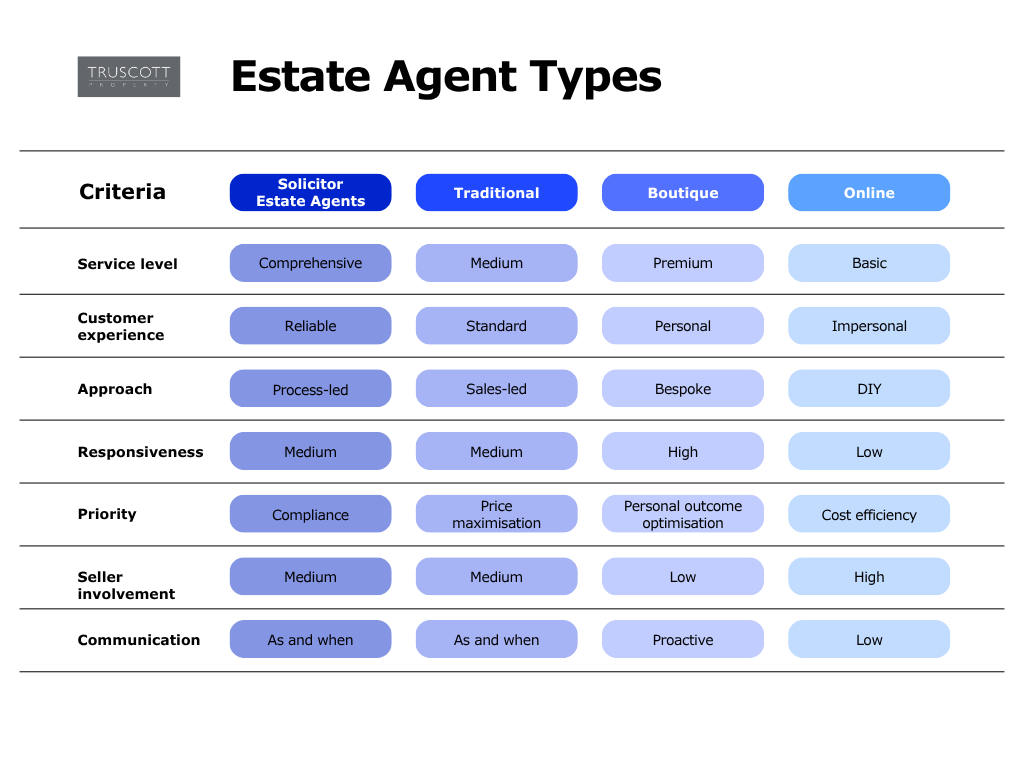
What types of estate agents are there?
What services should I expect from a boutique estate agent?
A well-run Edinburgh boutique estate agent will typically offer:
- A tailored marketing strategy for your specific property
- Agile pricing strategy anchored in current market behaviour
- High-quality photography, Home Report, and overall presentation
- Supplier and partner management
- Targeted buyer qualification, engagement, and nurture
- Viewing management
- Portal management
- Offer negotiation
- A consistent point of contact
- Ongoing, thoughtful, and proactive guidance throughout the sale
This white-glove approach to estate agency is designed to maximise both value and client experience. From the initial consultation to completion, every aspect of the process is tailored to clients’ needs and is fully managed, ensuring a seamless journey where no detail is overlooked.
Is it better to use a solicitor estate agent?
Solicitor estate agents offer a combined legal and sales service, reducing the number of parties involved. Given their legal background and often high volume, solicitor estate agents tend to prioritise compliance, efficiency, and risk reduction through tried-and-tested standardised processes and strategies. While this approach can streamline transactions, some sellers may feel they are treated more like case files than valued clients, resulting in a less personal relationship with their agent. The process can also feel lacking in personalisation and innovation, sometimes leading to frustration. In addition, professional and regulatory obligations may restrict how solicitor estate agents can engage and communicate with prospective buyers, limiting opportunities to build rapport and differentiate the property.
Boutique agencies, on the other hand, typically offer a more personalised and client-focused experience. With a strong focus on agile, tailored marketing strategies and a hands-on approach, they are well-positioned to adapt to ever-shifting market conditions and individual client needs. This flexibility enables them to present each property in its best light and deliver a more engaging, responsive service. Their typically lower case volumes also allow agents to maintain a detailed understanding of every instruction and devote more time to building relationships with and nurturing prospective buyers.
Ultimately, the right choice depends on whether you value the safety and convenience of an all-in-one standardised service or a more bespoke, client-focused sales strategy.
What fees do estate agents charge in Edinburgh?
Fees typically range from 0.75% to 1.5% + VAT, with boutique services sometimes positioned above this.
What’s most important is understanding the value behind the fee, which will drive how your property will be presented, marketed, and managed.
What questions should I ask prospective estate agents before hiring one?
- What is your fee?
- What’s the market like in my area, selling fast or slow?
- What were recent sales nearby and what did similar homes achieve?
- What’s special about my home that will attract buyers?
- How will you reach the largest audience possible?
- When have you last sold a home like mine and what value did you achieve compared to the Home Report?
- What would you do if my property was not selling as quickly or at the price you expected?
- What is your marketing strategy for properties like mine?
How can I research an estate agent’s local sales performance?
- Review listings and sold prices on Rightmove and Registers of Scotland
- Compare asking versus achieved prices
- Look at the time spent on market
- Read verified reviews
- Ask for recent examples of comparable sales
Do all homes go to a closing date?
No. While common in competitive situations, closing dates are not guaranteed or always the best strategy. A good agent will advise on whether this approach is appropriate based on your property, priorities, and current demand.
Choosing the right estate agent is one of the most impactful decisions of your sales journey. Beyond price and credentials, the best estate agents will take time to understand your property, priorities, and local market - all the while showing a strong performance track record.
By taking a thoughtful, structured approach to your estate agent search, you will be well placed to find the best real estate agent in Edinburgh for your needs. Whether you opt for a traditional firm or a more tailored, white glove estate agency, the right partnership will make all the difference to both your achieved outcome and your overall experience.
Ready to start your sales journey? Request your complimentary market appraisal with Truscott Property here.